Construction contractors succeed or fail based on how they approach equipment costs. Over-invest and there’s too much cash tied up in equipment sitting around waiting for jobs. Over-hire and those costs can build up quickly on long duration projects. But get that balance wrong and it’s not just profitability at stake—it’s capacity for work that’s denied.
Contractors who consistently win bids and maintain profitability know that it’s not about hiring the cheapest option—but about determining the best choice with the capacity to remain flexible to challenges that require scaling.
Ownership Costs Complicate Equipment Decisions
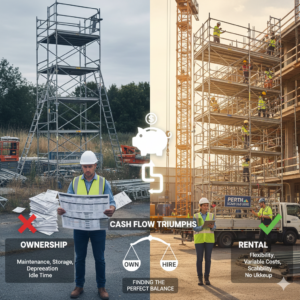
Equipment ownership seems like a straightforward approach—one payment, access when needed, no additional rental costs. Yet ownership has costs which complicate ownership decisions without the proper tracking in place.
There are inevitable maintenance and repair costs. Scaffolding must be checked and maintained. Equipment must be moved from project to project which uses time and fuel. Although storage is free of charge, rent needs to be paid for where equipment is kept. Insurance costs, depreciation, and replacement value all factor in regardless of whether it’s in the yard or being actively used.
When equipment isn’t consistently used, however, that’s when expenses become losses on the balance sheets. If 80% of scaffolding is out 80% of the time, it pays for itself as a purchased equipment option over time. However, if that same scaffolding is sitting there for 50% of the year, it becomes dead weight on the balance sheets.
When Renting Makes More Sense
Renting transfers the costs from fixed to variable. There is no longer capital tied up in owned equipment; there are just payment and payables for what is used when it is being used. This provides a much more flexible alternative to ownership.
When projects involve changing needs for equipment, hire makes more sense. Large scale scaffolding may be needed on one project for three weeks and then smaller access will be necessary for another month thereafter. Companies who offer scaffold hire perth give access when needed but also removal when projects are completed as opposed to ownership which sits around costing the same amount rent as it would if it were being utilized on another project in the meantime.
Seasonal considerations make hire a better option. Contracts may be busy during summer months when less scaffolding may be necessary during winter months. Why pay for equipment that isn’t being used? Hire makes more sense since businesses can scale based on current work and need as opposed to maintaining year-round usage.
Which Equipment Is Not Worth Owning
When equipment does not make sense to own for most contractors, there are several categories which should be assessed. For instance, specialized equipment which is used infrequently falls into the category where ownership makes no sense. The cost of ownership outweighs any potential hire acquisition.
Access often falls into this category. Unless scaffold is absolutely needed in every job, hiring is better than buying. The hire company deals with maintenance, inspections, storage and replacement—all expenses which do not result in value contribution for the contractor.
Larger options fall into this category as well as access systems—tower scaffolds needed for high rises or specialized access systems are far too costly to own for minimal use.
Make Decisions Per Project
Each project should be assessed separately. A three-month project with steady access needs is different than a year-long project with changing access requirements. Duration, usage intensity, and what’s needed determine whether hire or ownership makes sense.
Short-duration projects almost always lend themselves to hire. Set up once, predictable costs accrued with minimal need for much scaffolding after the project ends mean there’s no need for additional associated costs. Long-term projects need to be assessed more closely; extended hire may accrue more costs than purchase options but only makes sense if it will be needed sooner rather than later.
Smart contractors assess on a per-project basis. Sometimes they hire their mainstay basic needs but specialize in necessary extras by buying them. Other times they’ve hired everything but calculated per-project pricing into the contract.
Cash Flow Triumphs Over Ultimately Cheaper Costs
Even when ownership totals less than hiring over time does not negate cash flow management from a hire perspective.
Construction companies need working capital to purchase materials, pay wages, and ultimately cover gaps between billed portions of project progress.
That capital cannot be tied up in equipment loans if it’s going to be useless elsewhere—and while it’s virtually true that a $50,000 scaffold purchase will save money over five years of hiring payment, it’s also true that if that same company could use the $50,000 payment for other projects or maintaining flexibility due to gaps, there’s potential for comparative savings never shown in simplistic buy vs hire math.
Hire payment comes from the contracts determined assessment of efforts needed rather than upfront costing requiring instant payment.
The Quality Hire Problem
Not all hire options are created equal; cheap options abound but those options are hardly well-maintained equipment that can guarantee results on jobs. Missing parts, breakage with work arounds or failure to comply with safety requirements all cost time and create unsafe jobs.
Quality hire options boast properly maintained equipment with replacement parts for compliant completions. Paying that little bit extra per week saves time and money down the line with reliability over discouraging delays from bad hiring options.
It’s a simple lesson contractors learn fast when they use suppliers who succeed versus fail. The cheapest rate rarely wins the day unless delay after delay creeps onto job sites.
Finding the Perfect Balance
Successful contractors rarely rely solely on ownership or exclusively on hires; they balance both out of necessity—and good sense—to find a positive approach for their constant needs versus their specialty endeavors.
As such, what looks best depends on what kind of work is done. A residential renovation contractor may own small basics but hire larger systems; a commercial contractor might hire all access systems to maintain their capital through larger projects elsewhere.
Staying Updated Creates Synergy
As such, consistent reviews help balance this equation over time. With assessments of what costs are being accrued through hiring options create the ability to see what hasn’t moved often enough makes sense to own instead and what’s sat outside too often looks better as an occasional hire.
Profitable Decision Making Changes Everything
Equipment costs directly impact jobs’ profitability potential but also contractors’ ability to act with integrity for their business health. Managing this well means it’s not about hiring the cheapest option but making good decision on each project based on cash flow considerations and balancing owned versus hired supply needs between metrics that supports the business as opposed to ruining it.
Get this right and its seamless profitability gained with flexible opportunities taken elsewhere without capital tied up in gear that will only sit around sometimes.
It’s not about making it all work as ownership or hiring everything—it’s about knowing where each option makes the most sense and integrating decision-making that benefits what should otherwise be profitable work instead of chainlinking obligations that kill what will inevitably become many contracts that span across average construction seasons or years.
Those who fail struggle with equipment costs while those who find success normalize this expense when it should truly be a decision that’s two fold at best: enabling profit rather than allowing something to possessors become a detriment for intended acquisition.